Following Lord Vespasian's claim, on page 1, that no matter has really been found to disprove ICS yields, an idea as absurd as it's false, on the seventh page of the recent SW firepower thread at SBC, Vympel posted verbatim, in post 170, another calculation from those available at SDN; the one based on "Shield of Lies".
Most importantly, we first need to know what the text really said.Mike Wong, @ stardestroyer.net wrote: Shield of Lies
- Ploven
Source Data:
The Star Destroyer Forger suppressed a rebellion on Gra Ploven by creating steam clouds that killed 200,000 Ploven citizens in three coastal cities (ref. SWE).
Energy Estimate:
Since water vapor is normally much less dense than air, it tends to rise rapidly in the atmosphere. Therefore, the only way to affect coastal cities with an oceanic vaporization event is to heat the water to the point where it not only boils but it gains enough pressure to create a hemispherical "mushroom cloud" formation.
In order to kill hundreds of thousands of citizens in sparsely populated cities like the Ploven cities, the mushroom cloud would have to stretch at least 5km inland at its deepest point, so that it covers approximately 40 square kilometres. This is fairly conservative; such a cloud would quickly rise away and citizens protected in shelters or even well-built homes would survive. Only exposed citizens would be killed.
If the mushroom cloud is to spread horizontally, it must be denser than air. The density of room-temperature air is roughly 1.16 kg/m³ (ref. Fundamentals of Heat and Mass Transfer 3rd Edition), so the steam must be pressurized and heated to at least 0.2Mpa and 150 degrees Celsius. The enthalpy of steam at that temperature and pressure is 2.8 MJ/kg, while the enthalpy of surface water is 0.4 MJ/kg (ref. Engineering Themodynamics by Reynolds and Perkins). Therefore, 2.4 MJ/kg is required to raise the water from one state to the other.
The mass of water in a 5km radius hemispherical steam cloud at atmospheric density is 3.04E11 kg, therefore at least 730,000 TJ would be required to generate the steam cloud. However, not one but three coastal cities' inhabitants were boiled alive. Since 730,000 TJ are required to pacify just one city, 2.2 million TJ are required to pacify all three cities.
Weapon Breakdown:
Unfortunately, we don't know how many shots were required to accomplish this feat. We can determine that the cloud must have been created with a "one-shot" massive energy input to create the necessary effect; any sustained low-power process would create the steam but not at the necessary pressure (the pressure is a side-effect of the great speed at which the cloud is formed).
If a single blast was fired at each city, this would lead to energy estimates of 730,000 TJ (174 megatons) for the heavy cannons (in spite of the impedance induced by firing through a planetary atmosphere). If a 60-shot broadside was fired at each city, this would lead to energy estimates of 12,200 TJ (3 megatons) for the light cannons.
The act of vaporizing such large quantities of water at such speeds is a high-energy event that requires energy levels in the range of hundreds of megatons at the very least. This is somewhat lower than the BDZ firepower estimates, but it is likely that the Forger's weapons were not set to full power- this was an urban pacification exercise rather than an act of wanton destruction.
This actually represents a fascinating method of urban pacification; simply destroying the cities with direct bombardment would also eliminate the economic value of the buildings, industries, etc. But a superheated steam cloud can eliminate rebels without destroying the buildings. The only problem with this method is the high energy expenditure; mere nuclear weapons cannot perform such a feat (witness the relatively insignificant steam clouds created by 20th century underwater nuclear testing), and they create high radiation levels. Therefore, only turbolasers can accomplish the task cleanly and efficiently.
We get to understand that the citizens were killed by being engulfed in hot steam.Shield of Lies wrote:"I've also reviewed your trial record, Davith Sconn," Leia said evenly.
"You were the executive officer of the Star Destroyer Forger when it suppressed a rebellion on Gra Ploven by creating steam clouds which boiled alive two hundred thousand Ploven in three coastal cities."
Three coastal cities were hit, for 200,000 casualties, making an average of 66,667 kills per city (although this is value is not necessarily representative of the true casualties ratio per city).
First of all, this calculation is supposed to provide a solid low end figure for the ICS-like numbers, themselves being absolutely increased from erroneous interpretations of BDZ events. This is why BDZ are referenced here. As such, as an alternative to the destruction being produced by the fire from heavy turbolaser turrets, the high figure is generously offered as the sum of all side cannons firing at once; here, 60 pieces, each firing a blast also conveniently rounded up to 3 megatons. Those being the "light cannons".
In other words, megaton-level point defense cannons.
It is not surprising that this kind of claim surfaces, and proves essential to ICS cultists.
Still, we never get the proof that the light cannons would even have the necessary range to conduct orbital bombardment, but I guess it's not so important after all.
In the last paragraph, Wong points out that the amount of steam produced by an underwater nuclear blast would be limited.
Observe the results of the 23 KT Baker test on the following video. At 0:34, Mark Hamill enjoys the fresh air blast.
The bomb was apparently detonated 22.5 m underwater, at equal distance from the seabed and the surface.
We can see that a white and luminous ball does break through the water surface briefly. As per the description from the wiki page, the spray dome would be the killer in the scenario above. The gas bubble (fireball) pushed water and dust upwards and sideways.
Most likely, the megaton shots would need to be at a proper depth: too shallow the shot, and the people on the surface would be cooked by a fireball, and too deep, the surface radius would begin to be too short than its maximal reach at a proper mid-depth.
It seems the bubble of the Baker test created a gap with a radius of more than 150 meters; sideways, obviously, since the actual depth was largely surpassed at that point. This is similar to surface and airburst figures obtained here at such yields.
It appears that the actual amount of steam, although impressive, most likely got lost upwards, and whatever was pushed sideways didn't very far.
It's quite a problem here, as this procedure would be very difficult to achieve if one wanted to avoid typical fireball cooking while being sure to hit the shore with enough steam and not fail, and thus fall into the "mere" blast radius (a rather tame one, due to the nature of the explosion).
Good luck.
He uses a surface area of at least forty square kilometers.
He has obviously obtained the surface area by pinning ground zero on the shore, with his radius of 5 km.
It is rather obvious that that close, even a medium kiloton blast will certainly produce much more fire and air blast than any steam whatsoever. Let's not even talk about a megaton blast.
I'm baffled that one can cite those numbers without even giving them a second look. Now, 174 megatons in total, on the damn beach.
Steam?
Megaton shots will require much water to prevent the fireball from reaching the surface. Most water depths near the shores hardly come anywhere close to that.
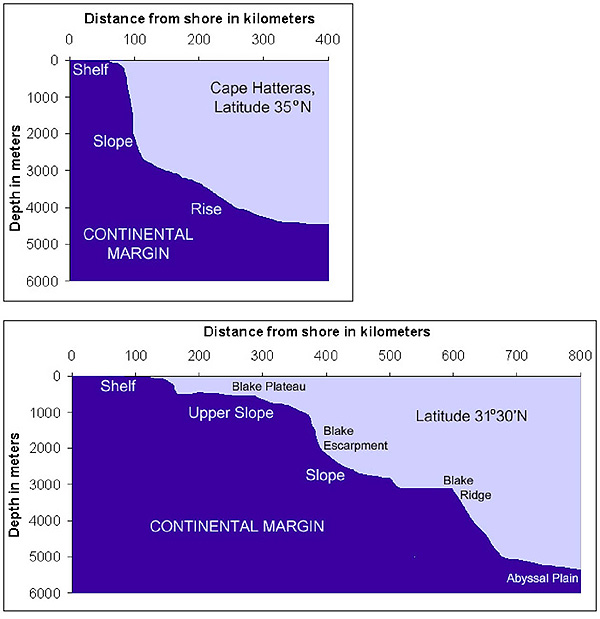
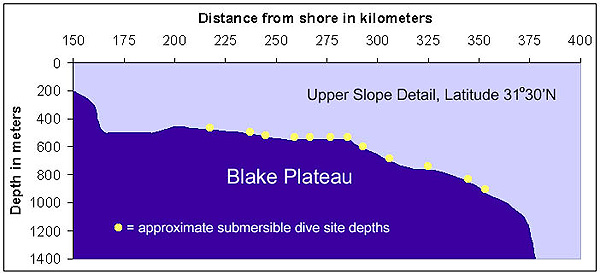
When we get to look at three examples (1, 2) of the slope of underwater cliffs, we see that we get to move hundreds of kilometers seawards before we begin to get depth of a few kilometers necessary for megaton explosions.
Then, by taking into consideration the usual fireball sizes of megaton detonations, we can see that one couldn't prevent the fireball from breaking the surface and expanding massively before the steam band could even be pushed far enough towards the shore.
It goes without saying that the extreme fireball radii from nuclear explosions up to 174 megatons would never find enough water before simply being too far to have the steam fronts reach the shores.
It doesn't matter, really, since we know that if the Forger had to produce a huge steam radius, a megaton blast would have been necessary, and that would only be possible far from the shore. As we've seen, the distance from ground zero to target increases faster than the required depth, with, on the best case scenario, a depth of 1 km 100 km off the coast, and in general an increase of 200 km for each kilometer of depth.
It is that ridiculous.
Wong considers this "a fascinating method of urban pacification; simply destroying the cities with direct bombardment would also eliminate the economic value of the buildings, industries, etc."
He is very wrong, obviously.
Let's remember what he said in the paragraph preceding that bit:
"The act of vaporizing such large quantities of water at such speeds is a high-energy event that requires energy levels in the range of hundreds of megatons at the very least. This is somewhat lower than the BDZ firepower estimates, but it is likely that the Forger's weapons were not set to full power- this was an urban pacification exercise rather than an act of wanton destruction."
Didn't he realize that his scenario had him drop nearly 200 megatons on the shore, at the doorstep of three cities? What kind of idiot would imagine one second to be able to merely kill the population without harming the structures?
It's important to point out that there are not enough details to claim that the bombardment was achieved in one salvo.
Wong says that if each city was hit by one blast, each blast had to be worth 174 MT, based on the conservative assumption that it had to cover a radius of 5 km inland, 40 km².
...
And people actually quote that?
The unique caveat to this theory, according to him, is the energy expenditure. Which is kinda funny, when you think of it.
"The only problem with this method is the high energy expenditure; mere nuclear weapons cannot perform such a feat (witness the relatively insignificant steam clouds created by 20th century underwater nuclear testing), and they create high radiation levels."
Even if nuclear explosions turn like a third of themselves into something else than thermal energy, it doesn't really matter. Even assuming that turbolasers are 100% thermal (which they're not since they're known to explode and even produce radioactive waste - so much for the clean mean of destruction), numbers don't change dramatically. Heck, his whole method would be completely ruined if the turbolaser didn't happen to precisely deliver the same kind of power as a nuclear explosion. And since we do see TL bolts move, they're obviously going to deliver their energy into a given target much slower than a nuclear explosion.
Simply put, the less rapid expansion, the shorter the steam range. Obviously, going three times more thermal than a nuke but being many times slower to deliver a yield at a given point will actually fail to produce an expanding steam front: You may actually produce more steam, but it will certainly have less drive to expand beyond the point of impact of the bolt.
Everything about his premise is flawed from beginning to end.
Let's not stop there!
Why assume that a radius of 5 km inland is a conservative premise?
With an average of 66,667 inhabitants, It may not be necessary to have the steam reach that far.
A conservative stance would certainly consider that the vast majority of the inhabitants of a given city were exposed to the steam, at least over 90%.
Besides, it would also consider the highest population densities one can find, although that one would logically prove detrimental to the former factor: the more people in a given area, the greater the density of high stories structures, which make death by steam (...) more difficult.
We'd require a much greater radius if most Ploven happened to be indoors at the time of the attack, but that is for the high end, and what I'm doing here is proving that the conservative figure is nothing like claimed by M. Wong at all.
It also depends on Davith Sconn's intent. Did he go for a mere demonstration, or really wanted to maximize casualties without hitting the structures too hard?
Someone looking to use steam as the efficient killing medium would obviously look for the best opportunity, and seize the moment when most Ploven would be exposed.
If we want to go look for a high percentage of death per inhabitants, we must assume an easily exposed population.
However, it happens that even in highly populated cities, at given times of the day, the amount of people found walking outside buildings is particularly high. Notice that an average population of 66,667 inhabitants is hardly that big. It's what you find in a 1 million people city's football stadium for example. We needn't limit ourselves to some working class, as tourists or people simply enjoying their time will also ambulate in the streets, and above all, also amass on the beach. See there.
Combine this with a high population density such as those found here, and you'll realize that with less than two square kilometers, you already have reached above the averaged casualties figure.
Yet, even this proves problematic, as the only way to reach even 1 km inland still require a steam cloud radius of 800 meters. Based on the Baker test, this would require a greater yield. Unfortunately, this is not possible consider where the bolt is supposed to land: you're just ending producing fire and air blast and little steam at all.
But the way Ploven live and how they build their structures is more important.
Well, guess what? It is possible that the Ploven are aquatic sentients nicknamed "little finbacks".
Now, the obvious question would be what would a coastal city built by an aquatic life form look like?
Coastal doesn't mean it has to be built on the land. It just needs to refer to a coast, in general be near a coast.
For all we care, most of their cities could be found underwater, and with the buildings at the surface surrounded by water.
I guess we don't need that much firepower to produce the deadly steam then.