It occurs to me that my website does not provide too much detail on the "diesel" fusion apparently used in Star Wars, and very few people have actually talked about the whys and wherefores of "diesel" fusion.
As with the warp speed paradigm which I found being misquoted and misrepresented at ST.com with surprising frequency, I expect that almost nobody who disagrees with the idea of "diesel" fusion actually knows what it is or why it is the most elegant theory that explains the curiousities of the "movie canon," as it is known. So I'd like to open the floor to questions (and give answers) about diesel fusion.
Questions and answers about "diesel" fusion
-
Jedi Master Spock
- Site Admin
- Posts: 2166
- Joined: Mon Aug 14, 2006 8:26 pm
- Contact:
-
Praeothmin

- Jedi Master
- Posts: 3920
- Joined: Mon Oct 23, 2006 10:24 pm
- Location: Quebec City
-
Jedi Master Spock
- Site Admin
- Posts: 2166
- Joined: Mon Aug 14, 2006 8:26 pm
- Contact:
"Diesel fusion" is a catchphrase that has come to refer to the idea that Star Wars starships commonly use fuel that is mostly hydrocarbon, and that this fuel is burned in fusion plants. It does not refer to the diesel cycle or "actual" diesel engines.
-
GStone
- Starship Captain
- Posts: 1016
- Joined: Wed Aug 16, 2006 10:16 am
- Location: Undercover in Culture space
-
Mr. Oragahn

- Admiral
- Posts: 6865
- Joined: Sun Dec 03, 2006 11:58 am
- Location: Paradise Mountain
Is the "catchphrase" thing a retconning from a more literal stance?
What about the arguments advanced by SDN, about the compression, the smell, the flammable liquid in the cutscene with Anakin in ROTS (still canon I think), etc?
I've noticed that the Starwars Souce Book points to the X-wing reactors using fission chambers.
The OT ICS says that a variety of sublight engines exploit the principle of ion thrust, achieved through reactants and various electronic accelerators from potent fuel mixtures.
Such fuelds can come in the following forms:
- pressurized radioactive gas.
- volatile composite fluids.
- explosive liquid metal.
All are said to expel, without any particular distinction, radioactive ejecta, and that's why they're only used when ships are clear of facilities or personnal that could be harmed.
Please note that the ICS uses the exact same schematic from the SWSB mentioned above, and the same source shows that Y-wings use "ion fission reactors".
What about the arguments advanced by SDN, about the compression, the smell, the flammable liquid in the cutscene with Anakin in ROTS (still canon I think), etc?
I've noticed that the Starwars Souce Book points to the X-wing reactors using fission chambers.
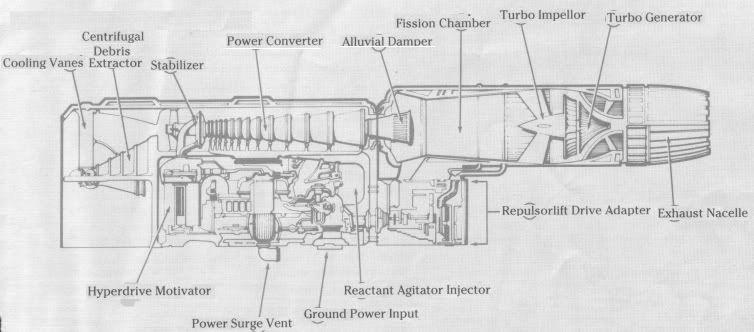
The OT ICS says that a variety of sublight engines exploit the principle of ion thrust, achieved through reactants and various electronic accelerators from potent fuel mixtures.
Such fuelds can come in the following forms:
- pressurized radioactive gas.
- volatile composite fluids.
- explosive liquid metal.
All are said to expel, without any particular distinction, radioactive ejecta, and that's why they're only used when ships are clear of facilities or personnal that could be harmed.
Please note that the ICS uses the exact same schematic from the SWSB mentioned above, and the same source shows that Y-wings use "ion fission reactors".
-
Cpl Kendall
- Jedi Knight
- Posts: 513
- Joined: Tue Jan 30, 2007 7:30 pm
- Contact:
The compression refers to the fact that actual diesel won't ignite from a spark or flame, it has to be compressed in the engine to ignite. I don't recall this scene but from the description of it, IE: liquid (termed diesel) being ignited by a spark, would not work if it was literal diesel.
But apperently the "diesel" in this theory is not actual diesel but rather some unknown hydrocarbon. Silly people thinking that the term diesel would actually mean that instead of some random fuel.
But apperently the "diesel" in this theory is not actual diesel but rather some unknown hydrocarbon. Silly people thinking that the term diesel would actually mean that instead of some random fuel.
-
Praeothmin
- Jedi Master
- Posts: 3920
- Joined: Mon Oct 23, 2006 10:24 pm
- Location: Quebec City
Well, people go with what they know...Cpl. Kendall wrote:Silly people thinking that the term diesel would actually mean that instead of some random fuel.
I was pretty sure JMS wasn't talking about "our" diesel, simply because to achieve the accelerations, the thrust these vessels achieve on "normal" diesel fuel would be, to me, ludicrous.
But, not knowing what JMS meant, I had to ask what this "Diesel Fusion" was...
After all, I'm more an "unleaded" kind of guy... :)
-
Jedi Master Spock
- Site Admin
- Posts: 2166
- Joined: Mon Aug 14, 2006 8:26 pm
- Contact:
The lower end of the range comes from the net energy yield of fusing the total hydrogen content of a "heavy" decane into helium in a nice and neat D-D reaction.GStone wrote:How did you come to the figures on the site for hydrocarbon fusion? I can imagine that you'd use what you might get out of fusing hydrocarbon, but that's gotta be multipled for x number of times for an estimated range. How'd you come up with that?
The upper end of the range comes from the net energy yield of ripping apart everything and fusing it to iron-56.
Both of these are obviously a little flexible. We can probably find something other than pure decane to play with with a slightly higher percentage of fuel, and using a non-heavy decane drops the lower end of the net yield by one half.
-
Jedi Master Spock
- Site Admin
- Posts: 2166
- Joined: Mon Aug 14, 2006 8:26 pm
- Contact:
Diesel fuel is, chemically speaking, close to the ideal match for SW fuel under these considerations. So is high octane gasoline. I expect actual fuel to also contain some trace amounts of heavy ammonia and heavy water in addition to heavy hydrocarbons (most likely largely alkanes in the 8-12 carbon range), and perhaps a few other organic compounds.Cpl Kendall wrote:The compression refers to the fact that actual diesel won't ignite from a spark or flame, it has to be compressed in the engine to ignite. I don't recall this scene but from the description of it, IE: liquid (termed diesel) being ignited by a spark, would not work if it was literal diesel.
But apperently the "diesel" in this theory is not actual diesel but rather some unknown hydrocarbon. Silly people thinking that the term diesel would actually mean that instead of some random fuel.
Presumably, in Star Wars, fuel is largely skimmed from smaller gas giants (which mix ammonia and water in with their methane), and then enriched and treated. A little nitrogen and oxygen will gum up the reactor no more than the larger amounts of carbon going through it. You might be able to burn it in a diesel engine anyway.
The fact that actual gasoline and actual diesel fuel is not particularly vulnerable to stray sparks is typical of films, which often make unrealistic portrayals of how explosive gasoline is. Diesel is even harder to ignite than gasoline.
However, it will burn quickly and fiercely if successfully ignited.
You basically need to have something that's glowing red hot and has enough energy to heat a small local portion of the fuel enough to ignite it before it cools (i.e., under normal conditions, somewhere around 250 degrees celsius).
This is difficult to achieve normally. However, blaster bolts, turbolaser bolts, and lightsabers tend to be very high energy effects. A stray blaster bolt, at 10-250 kJ, has enough energy to heat up to a liter of fuel to its normal ignition point - and once the fire starts, it can be difficult to contain.. A stray lightsaber sweep through the fuel is going to be - if anything - more energetic than a blaster bolt.
So while Obi-Wan is a worrywort, he's certainly no worse than the worryworts who suggest that it's a good idea not to light up while you're sloshing gasoline into your car, and ship grade weapons have a trivially easy time setting these sorts of fuel stores on fire.
-
Jedi Master Spock
- Site Admin
- Posts: 2166
- Joined: Mon Aug 14, 2006 8:26 pm
- Contact:
I came up with the idea that Star Wars ships fuse hydrocarbon fuel solely on the basis of the movie level evidence. The screenplays, novelizations, and films pose a puzzling conundrum that the EU fails to answer.Mr. Oragahn wrote:Is the "catchphrase" thing a retconning from a more literal stance?
What about the arguments advanced by SDN, about the compression, the smell, the flammable liquid in the cutscene with Anakin in ROTS (still canon I think), etc?
I've noticed that the Starwars Souce Book points to the X-wing reactors using fission chambers.
The OT ICS says that a variety of sublight engines exploit the principle of ion thrust, achieved through reactants and various electronic accelerators from potent fuel mixtures.
Such fuelds can come in the following forms:
- pressurized radioactive gas.
- volatile composite fluids.
- explosive liquid metal.
All are said to expel, without any particular distinction, radioactive ejecta, and that's why they're only used when ships are clear of facilities or personnal that could be harmed.
Please note that the ICS uses the exact same schematic from the SWSB mentioned above, and the same source shows that Y-wings use "ion fission reactors".
However, we can consider the references to fusion and fission (ultimately different sides of the same coin) in the EU to be additional supporting evidence. Any fusion reactor advanced enough to, say, tear apart a human being and spit out raw iron-56 plasma is probably capable of also conducting fission on the same level of frightening efficiency.
When I say this, of course, I am putting Star Wars fusion reactors several generations past Star Trek fusion in everything except possibly miniaturization.
Explosive metals worth putting into a fusion reactor include metallic hydrogen, and lithium (particularly lithium-6) It's hard to come up with a volatile explosive liqiuid metal under low temperatures.
Pure tritium - a radioactive gas - is worth using as a fuel if you're concerned primarily about mass, willing to replace your fuel pipes fairly frequently, and pressurizing heavily.
"Volatile composite fluids" is a very good match for the type of fuel that I'm deeming typical.
-
Cpl Kendall
- Jedi Knight
- Posts: 513
- Joined: Tue Jan 30, 2007 7:30 pm
- Contact:
So you base this on a scene that is not admissable evidence due to it not being in the film and there is no mention or hint of this mystery hydrocarbon in any of the other movies.Jedi Master Spock wrote: I came up with the idea that Star Wars ships fuse hydrocarbon fuel solely on the basis of the movie level evidence. The screenplays, novelizations, and films pose a puzzling conundrum that the EU fails to answer.
So to sum up: what you basically have is a solution for a problem that doesn't exist. How much time did you waste on this intellectual masterbation?
-
Cpl Kendall
- Jedi Knight
- Posts: 513
- Joined: Tue Jan 30, 2007 7:30 pm
- Contact:
-
Mike DiCenso
- Security Officer
- Posts: 5839
- Joined: Fri Aug 18, 2006 8:49 pm