Hyperspace Lanes

For polite and reasoned discussion of Star Wars and/or Star Trek.
watchdog
Jedi Knight
Posts: 342
Joined: Sun Dec 31, 2006 12:26 am
Location: Not at home

Post by watchdog » Tue Aug 19, 2008 8:35 pm

Dont know if this adds anything useful, I posted this back in 2002 on SB;
Hyperspace Hazzards


In a recent issue of "Star Wars Gamer" magazine they feature an article on the Moddell sector where Endor is located. The article states that...
The fact that the Zuma (the region the Moddell sector is located in) is so little traveled means that hyperspace routes to the region are slow, uncomfortable and sometimes unsafe. Unfortunatly, those routes through the region are worse: Trying to navigate to Moddell is like picking one's way across a muddy briar patch-or, as some spacers say, like tiptoeing across an unmapped minefield. The hyperspace eddies and sinkholes that plague the region remain mysterious
So that the Empire could get their own ships into the area during the 4 years they were building the Death Star 2, they "Artificially extended" an existing route and


By planting non-mass S-thread boosters in hyperspace and moving realspace detrius from a thousand locations to avoid catastrophic mass shadows.
The so-called Santuary pipeline became harder to navigate through after the Endor battle due to "A combination of natural decay and the theft of any S-thread booster that could be located by smugglers."


The accompanying map of the sector shows a good sized nebula near Endor. Din pulsar sits in one corner of the nebula near a route between Endor and a system called Trindello. The article has this to say:
The combination of magnetic pulses and filaments of gas have made the Trindello-Endor route increasingly unstable, extending travel times between the two worlds and frying countless hyperdrives.
This problem with magnetic pulses frying hyperdrives is not new as in the "Tales of the Jedi" TP has Andur Sunrider and his wife Nomi had to replace a burnt-out ion exiter due to a magnetic storm they jumped through. The main body of the local nebula (called Monsua) are described as such:
While slow hyperspace routes and interstellar anomalies plague the entire Moddell sector, the fringes of the Monsua nebula are by far the worst. Scouts forge routes light-year by painstaking light-year, only to see them decay almost overnight, while other stars simply remain inacessable despite the best efforts of scouts and survey droids.

If the maps from NJO are to be believed, then there are 5 main hyperspace routes in the galaxy that allow fast, safe travel to most sections of the galaxy.Travel on a seldom-used path will be slower (127 LY on the Corellian run may take only an hour, but 127 LY on an uncharted path may take several hours). The RPG core book states that the main paths are well kept and constantly updated in the official astrogation records. One analogy would be trying to travel a well kept highway and later transfering to a dirt trail. in the case of the Moddell sector it would be like trying to travel a dirt trail with rain that keeps washing the trail away.
This is of course from the RPG that was released when Ep 2 came out, I figure it's all relative. The EU has many bits of info on hyperspace travel, the most interesting to me is how a magnetic storm can fry a hyperdrive if you jump through it, and then there is the hyperdrive cutoff, a system that is tied to a sensor that detects mass shadows in your path and cuts off the hyperdrive to avoid a collision. That is the premise the interdictor cruisers is supposedly based off of, the cutoff seems to drop you out of hyperspace inside of the detected gravity well rather than just outside of it (I recall characters trying to get out of the gravity well projectors of the interdictors so that they can escape into hyperspace again).

I see Mr. Wong is still cherry-picking the parts of the EU that he wants to represent the REAL Star Wars. He must think he's George Lucas.


User avatar
l33telboi
Starship Captain
Posts: 910
Joined: Fri Sep 29, 2006 7:15 am
Location: Finland

Post by l33telboi » Tue Mar 10, 2009 9:20 am

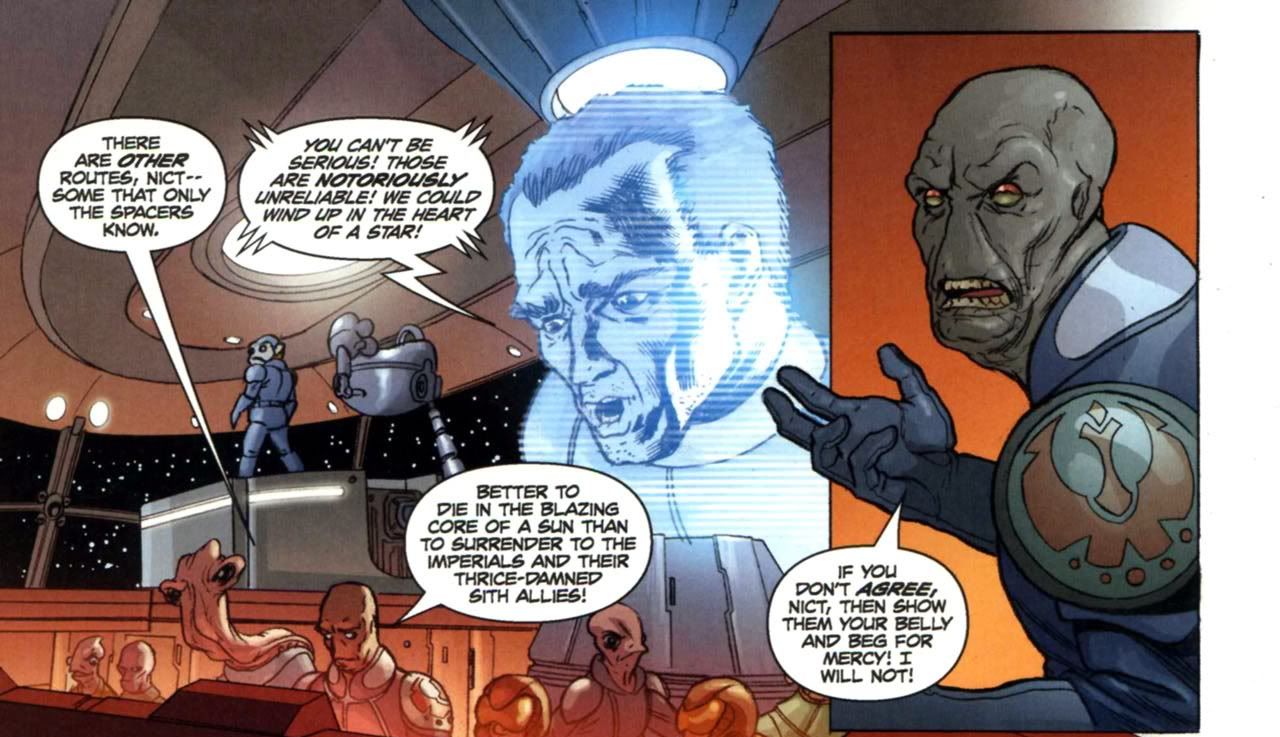
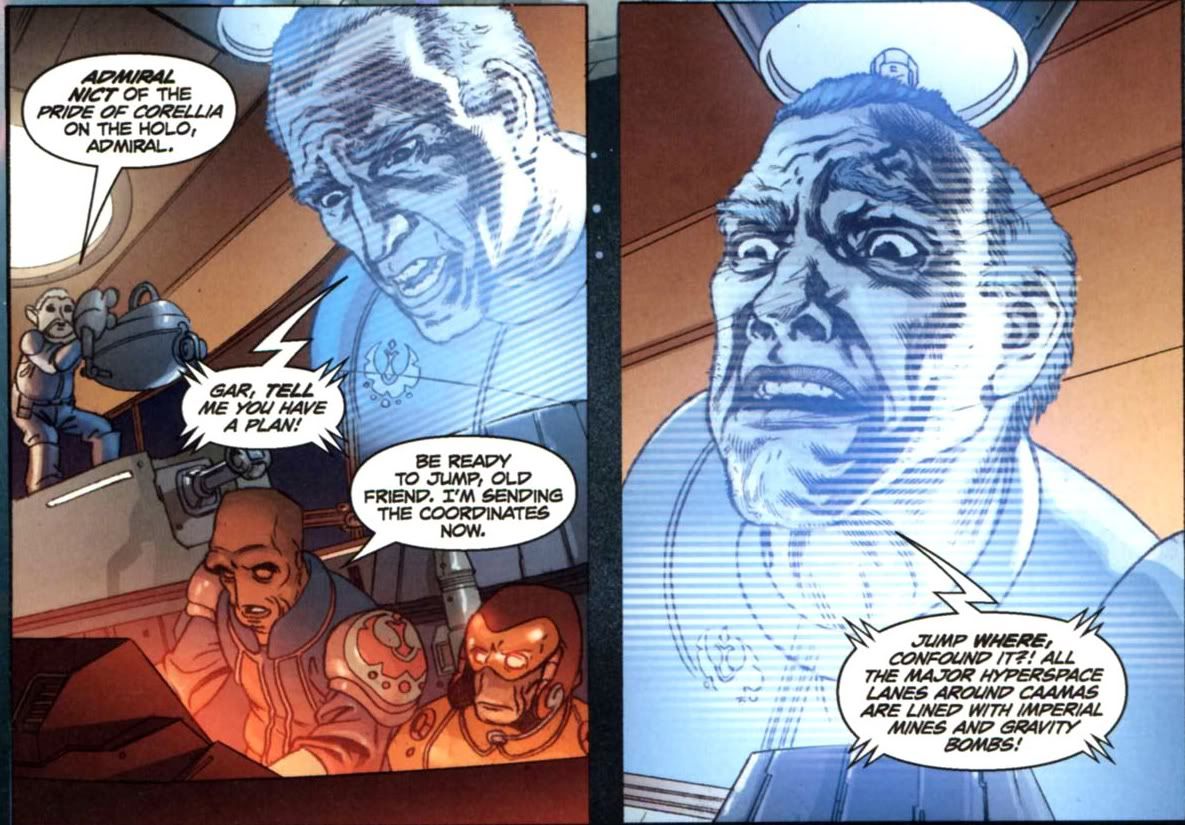
I know this is a bit of a dead thread, but there's apparently no rule against necromancy here, and I did find something rather interesting to add to the debate. More evidence of hyperspace mining from issue #21 of the Legacy comics.

Image

It seems this whole mining thing can actually be done quickly enough to trap fleets.

Image

Image

This little thing right here suggests that vessel can't travel in hyperspace without hyperspace lanes... at all. If they could do it, then why not simply do that to get a bit further away, and then when they're out of range of the mine-field use a major hyperspace lane? Instead, it's as if they can't travel at all - except of course that the Admiral knows of some older, apparently unofficial, lanes which ultimatly save them, even though they're notoriously unsafe.

User avatar
Mr. Oragahn
Admiral
Posts: 6865
Joined: Sun Dec 03, 2006 11:58 am
Location: Paradise Mountain

Post by Mr. Oragahn » Tue Mar 10, 2009 4:02 pm

watchdog wrote:
This is of course from the RPG that was released when Ep 2 came out, I figure it's all relative. The EU has many bits of info on hyperspace travel, the most interesting to me is how a magnetic storm can fry a hyperdrive if you jump through it, and then there is the hyperdrive cutoff, a system that is tied to a sensor that detects mass shadows in your path and cuts off the hyperdrive to avoid a collision. That is the premise the interdictor cruisers is supposedly based off of, the cutoff seems to drop you out of hyperspace inside of the detected gravity well rather than just outside of it (I recall characters trying to get out of the gravity well projectors of the interdictors so that they can escape into hyperspace again).

I see Mr. Wong is still cherry-picking the parts of the EU that he wants to represent the REAL Star Wars. He must think he's George Lucas.
Most puzzling is how the mere presence of debris can result into dramatic results for hyperspace travel.
The debris would need to be stupidly huge to start casting any form of relevant mass shadow that would be proportional to the gravity generated by each molecule.

This, as bizarre and almost stupid as it is, fits with TCWS where Anakin had to escape the debris field around Abregado's red sun (?) before activating the hyperdrive.
Yet is countered by Jedi Crash (the episode that features PaRappa).

User avatar
l33telboi
Starship Captain
Posts: 910
Joined: Fri Sep 29, 2006 7:15 am
Location: Finland

Post by l33telboi » Tue Mar 10, 2009 4:10 pm

Mr. Oragahn wrote:This, as bizarre and almost stupid as it is, fits with TCWS where Anakin had to escape the debris field around Abregado's red sun (?) before activating the hyperdrive.
I don't think gravity is the problem when it comes to debris. Running through a large piece of metal would probably rip the ship to pieces.
Yet is countered by Jedi Crash (the episode that features PaRappa).
They weren't in any risk of colliding with anything then. Sure, the ship was inside the atmosphere, but it was also pointed away from the planet. And besides, the episode guide says that the jump was risky and the chances of coming out alive were extremely slim.

User avatar
Mr. Oragahn
Admiral
Posts: 6865
Joined: Sun Dec 03, 2006 11:58 am
Location: Paradise Mountain

Post by Mr. Oragahn » Tue Mar 10, 2009 4:29 pm

l33t, what I notice is the recurring idea that a miscalculation will end with a prompt dumping into a star.
It may have to be considered. There's just no way they can be so troubled by the stars when there's just so much space around.
The fact being that a star system has its referential being the star, and thus the major beacons on the hyperspace grid.
Most ships would probably follow the major waypoints up to each system's center, then steer away, still in hyperspace, towards a planet, when approaching said system.
It would explain why, as the main structure of the hyperspace network is based on the stars, miscalculating the recent displacement of a star and its system, may lead you into said targetted star, possibly explaining the myth of the star collision, or at least the greater amount of collisions with stars.

The other point is just what an hyperspace route could, astronomy wise. The whole mass of the galaxy is in perpetual movement.
There are obviously motorways, in the sense of clear and large routes meant for almost straight forward simplistic hyperflight, with many small routes branching out, but requiring much more detailed calculations.

These smaller routes are what matter here, when a ship wants to depart from a planet. When you mine a route, you don't have to mine the whole route, but just put mines randomly, so ships are flying blind in the sense that they cannot see the mines and risks of collisions vary greatly. It's largely playing on the sense of fear.

But we're falling back onto the point of what an hyperspace route is. Consider that from a planet, there'd be a large combinations of departure points to leave a gravity well safely.
I'll try to flesh out this train of thought, but needless to say, I find it bizarre that there can be routes which would evade the mining if, basically, mining routes amounts to cutting most efficient exit paths.
Obviously, avoiding such mines would just mean executing a hook, pointing your ship to a point that's quite off track, but still in clean deep space, no asteroid, no debris, nothing, and join the motorway a bit further up or down. No big deal at all here.
But I guess those routes that point out of the system, away from the motorway, would be mined as well.

Would only remain, then, pseudo routes which are only wild paths which are filled with unpredictable mass shadows and barely charted space objects.

Depending on the range of a gravity bombs, it could either point out to a reasonnable total number of such mines deployed inside a system, to a number being simply too stupidly high to be credible.

Besides, even if we find an explanation about realistically mining exit routes from a planet, this will never explain how the CIS could literally mine out an entire quadrant of the galaxy, unless hundreds of thousands of at least 0.5 LY radius g-bombs have been deployed.

User avatar
Mr. Oragahn
Admiral
Posts: 6865
Joined: Sun Dec 03, 2006 11:58 am
Location: Paradise Mountain

Post by Mr. Oragahn » Tue Mar 10, 2009 4:35 pm

l33telboi wrote:I don't think gravity is the problem when it comes to debris. Running through a large piece of metal would probably rip the ship to pieces.
But those debris are not in hyperspace, and just too light to be a problem.
The only problem paused here would be during the acceleration phase, when ships jump into hyperspace. Possibly a collision then, or sucking debris with the ship, would be dangerous.
That said, a cruiser could displace a good amount of air and that didn't pose a problem, so we're obviously looking at solid objects posing a problem, or thick enough fluids like water perhaps, but certainly not air at pressures similar to see level on Earth.
They weren't in any risk of colliding with anything then. Sure, the ship was inside the atmosphere, but it was also pointed away from the planet. And besides, the episode guide says that the jump was risky and the chances of coming out alive were extremely slim.
Possibly. What I'll point out is that, by default, the ship was headed for a star, probably proving that stars are the fastest points of references taken by computers for jumps, and would explain why it knew that it was flying towards a sun.

That said, it also means that with enough time, any computer could plot a course and put a ship into hyperspace from within an atmosphere.

What is clear is that the gravity well of a planet is no longer that impossible region of space that makes any hyperdrive explode and dooms ships.

User avatar
l33telboi
Starship Captain
Posts: 910
Joined: Fri Sep 29, 2006 7:15 am
Location: Finland

Post by l33telboi » Tue Mar 10, 2009 5:05 pm

Mr. Oragahn wrote:But those debris are not in hyperspace, and just too light to be a problem.
Running over solid objects is still somehow possible in Hyperspace, as evidenced in "The Rising Force" when Qui-Gon says their ship would've been destroyed if it hit an asteroid while in hyperspace. And from what I recall, that debris in the field was about as large as the Twilight was, so running over it would definetly have been a major problem.
What is clear is that the gravity well of a planet is no longer that impossible region of space that makes any hyperdrive explode and dooms ships.
Well, from what's said in the episode guide, that is probably what would happen, and Ashoka and Anakin just got extremely lucky when they made the jump.

PunkMaister
Jedi Knight
Posts: 622
Joined: Sat Feb 14, 2009 1:25 am
Location: Ponce, P.R
Contact:

Post by PunkMaister » Tue Mar 10, 2009 5:17 pm

SailorSaturn13 wrote:A similar concept exists in Trek: ajou can move fastectories on which you can move faster.

On the other hand soe travels (like coruscant - dubrillion in "Vector Prime" DO last more than a week at peacetime, meaning that the fast lanes are VERY RARE and most planets nnowhere near them - indeed only few important worlds are connected by such lanes (and therefore are rich and important).
Umm... What?


The hyperspace lanes are simply well plotted hyperspace navigation routes.

And anybody doing trading would have well plotted navigation routes no matter what FTL you would be using.

User avatar
Mr. Oragahn
Admiral
Posts: 6865
Joined: Sun Dec 03, 2006 11:58 am
Location: Paradise Mountain

Post by Mr. Oragahn » Tue Mar 10, 2009 6:12 pm

l33telboi wrote:Running over solid objects is still somehow possible in Hyperspace, as evidenced in "The Rising Force" when Qui-Gon says their ship would've been destroyed if it hit an asteroid while in hyperspace.
An asteroid can be a large thing with some considerable mass, and thus a noticeable gravity field.
Solo came out of hyperspace into the Alderaan field. The idea that he'd have done so just outside of the field despite being hit as soon as streaks become dots is a stretch that is not worth the defense.
And from what I recall, that debris in the field was about as large as the Twilight was, so running over it would definetly have been a major problem.
If we consider that the danger only lies on the distance that is represented by the ship and the point in space where it will enter hyperspace, then any safe distance through that field would have been enough, meaning debris in real space would not be a problem in hyperspace.
The only problem would be the density of the hazardous debris field. The computers could plot a course, then a debris flies and intersects the path, boom.
Well, from what's said in the episode guide, that is probably what would happen, and Ashoka and Anakin just got extremely lucky when they made the jump.
They were extremely lucky without making any computation.
We're yet to be told why there's a good reason to think this risk would still exist when computers would be given time to make the calculation.

User avatar
CrippledVulture
Bridge Officer
Posts: 82
Joined: Fri Mar 16, 2007 8:10 pm
Location: Hovering over a stinking corpse somewhere.

Post by CrippledVulture » Tue Mar 10, 2009 10:01 pm

Han Solo:
Traveling through hyperspace ain't like dusting crops, boy! Without precise calculations we could fly right through a star, or bounce too close to a supernova and that'd end your trip real quick, wouldn't it?
Feel free to ignore my wild speculation, but something 2046 said earlier in this thread got me thinking. Star Wars hyperspace is constructed first as a dramatic element and as a functioning scientific concept second, if at all. That is to say there is a give-and-take based upon how the universe's creator imagined the society would interact with its environment.

What if hyperspace is a neighboring dimension in which the landscape is composed of these "gravitic mass shadows," essentially the magnified gravity wells of all objects in real space. For dramatic purposes, these shadows are so large and so powerful that they can affect the travel of vessels far beyond the range at which the body's gravitational pull would have any noticeable effect in real space.

The rules of physics are bent in hyperspace, allowing ships to travel faster than light (at least, relative to their home dimension). However, the dramatic trade off is that they must navigate the gravity-based, real space-derived terrain of this other dimension. Not because it makes any kind of scientific sense, but because it makes for an interesting story.

For me, this explains a lot of the weirdness we see in Star Wars.

It explains the Kessel Run, in which a ship with a robust hyperdrive and a clever captain could navigate a particular region's gravity fields using a shorter real space route and this would be an accomplishment.

It explains hyperspace lanes as the path of least resistance between the exaggerated gravity wells of nearby stars. Well-traveled routes would obviously be combed and maintained for safety.

It could also explain the variance in the way these lanes are treated as certain ships may be able to cut corners with less risk if they are small and/or have a hyperdrive optimized for such a venture (a scout vessel or smuggler). Large ships may have increased risk, and bureaucrats may cut corners by giving Star Destroyers and the like cheaper hyperdrives intending to use the lanes exclusively, saving power for weapons and shields.

It explains the constant worry in the films and EU that deviation from the hyperspace lanes will result in collision with a star. A miscalculation will direct a vessel toward the biggest gravity well in the region, most likely a star.

It also explains why this society is so ancient while the societies in other sci-fi would be flying around in psychic space creatures that they control with their minds (you know, besides the persistent dictators, wars, rebellions and whatnot). Quite a lot of effort was required to make hyperspace travel as safe as it is in the films, and no small amount is required to maintain it. Simply keeping things connected requires a considerable portion of their culture's attention.

That's how I'd write it, anyway.

User avatar
l33telboi
Starship Captain
Posts: 910
Joined: Fri Sep 29, 2006 7:15 am
Location: Finland

Post by l33telboi » Tue Mar 10, 2009 10:42 pm

I always thought the whole 'end up in a star' is just a turn of phrase and not literal. It's one of the worst possible outcomes of a miss-jump, so people keep talking about it as a real danger whenever plotting a course.

User avatar
CrippledVulture
Bridge Officer
Posts: 82
Joined: Fri Mar 16, 2007 8:10 pm
Location: Hovering over a stinking corpse somewhere.

Post by CrippledVulture » Tue Mar 10, 2009 11:06 pm

However, the chances of that actually happening are astronomically slim, and slamming into something dangerous, planet, asteroid, small moon-sized space station, star or otherwise is basically always the worst possible outcome.

Sorry to nit pick. I'm really just thinking out loud...

and then typing it.

User avatar
Mr. Oragahn
Admiral
Posts: 6865
Joined: Sun Dec 03, 2006 11:58 am
Location: Paradise Mountain

Post by Mr. Oragahn » Tue Mar 10, 2009 11:11 pm

I think it's logical to think that any gravity well sees its presence in hyperspace relatively increased, if hyperspace is a sort of pocket version of the universe.

Now, should we believe that there are legions of ships taking care of lanes to remove and destroy any possible foreign element on the lanes?

Well, it would take lots of resources. And many ships. Of course, the maintenance of lanes would explain why there are obvious clear and well used commercial lanes, and how mining those lanes would make said maintenance hard, thus crippling traffic.

The problem is that it promotes the idea that ships stranding off these paths are taking immense risks, and the EU is riff with many hyperjumps made from random points, and there is not a single time where you get the idea that the danger comes from lanes not being combed.

The danger is always identified as a lack of calculations.

It would require an extreme emphasis on the importance of combing hyperlanes to make your random off track courses that dangerous.

It's quite hard to make head and tails out of this in fact.

There's a possibility that any massive gravity well acts like some sort of magnet in hyperspace, which might even be used for slingshooting ships, but it's very dangerous and random, and immensely disturbs trajectories, making them fluctuate. I suppose a mass shadow would be like a phenomenon with a given radius of influence, but which edges would not be properly defined, more like the corona of a star, so you could find yourself flying through the mass shadow's equivalent of a tumultuous coronal mass ejection.

In fact, we could posit that the more mass shadow there is, the slower an hyperdrive will be, either by nature of the hyperspace physics, or by precaution (but I can't really see a point in slowing down since if your computer made a mistake or charts changed, you'll get likely destroyed anyway).

Therefore, we would not be talking about the mass of stars and planets, but about the global mass of whole systems.

Basically, we may summarize the laws of hyperspace navigation as such:

1. Jumping close to a large moon, a planet or a star can send your ship on a complete random course, as the more massive an object, the more random and violent disturbances it casts in hyperspace.
It would mean that in the "safe" proximity of such bodies, hyperdrives would still fly at slow speeds to correct courses due to eventual turbulences. Think of a slight change of trajectory when flying at 10 km/h and the same one but when flying at c.
When clear of turbulences, most likely well out of a star system, a ship could fly at maximum cruise speed, and even aim for peak speeds.

2. The gravity well of planets have increased attraction effects on ships. Therefore ships exit hyperspace at a safe distance from planets and stars. Such increased attraction causes strain on hyperdrives, which suddenly consume more power either to accelerate out or accelerate out of these fields, depending on if the ship is arriving or leaving, and also uses more power to maintain the field that protects a ship and its crew from the stress of hyperspace (something I think WEG explained in its guides). Thus any collision or close fly to such mass shadows burn hyperdrives.

3. Computers first plot their courses based on the center of mass of systems, based on latest charts and predicted drifts, with the main point of reference being the galactic core. Centers of mass of star systems (or any other group of large masses in a given small region of space) represent the basic and by default points of reference (aside from the core). Which means in a case of a miscalculated course, a computer may revert to a safe mode and aim for a nearby star system's center of mass if possible, with either positive or negative outcomes.

4. Any collision, even minor, with an object during the transition phase of a jump into hyperspace is extremely dangerous.

5. Fastest hyperspace routes are those which are the straightest and most distant to any group of large body masses.


Notice that this list of five point does not come as an explanation of what I talked about earlier on in the same post, that is, physically identified hyperspace conduits that would boost speeds.
However, it's rather clear that the lack of any chart would forbid a ship from experiencing fast travel.

This conception of hyperspace has severe limits. Major hyperlanes come close to systems, and it doesn't explain very well the speed discrepancies between the sort of one day trips from Tatooine to Coruscant (Darth Maul's voyage) or to Geonosis, Naboo or Kamino, although all these planets seem to be located more or less in the same region of space.

It is clear that the idea of unique, rare and extremely faster hyperspace conduits would solve a lot of issues. It would make hyperlane mining both reasonnably achievable are extremely sound, strategically.

So to the list above, I'd have to add the following rule:

6. The major and scanty hyperlanes are physical phenomena akin to massive streams, or more precisely rifts or wrinkles where hyperspace is "folded" to a greater extent, and thus permits ships to cross even larger normal-space distances at the same expense of energy.
Last edited by Mr. Oragahn on Wed Mar 11, 2009 12:49 am, edited 1 time in total.

User avatar
CrippledVulture
Bridge Officer
Posts: 82
Joined: Fri Mar 16, 2007 8:10 pm
Location: Hovering over a stinking corpse somewhere.

Post by CrippledVulture » Tue Mar 10, 2009 11:30 pm

I think the only point on which we disagree is the level of danger incurred by leaving the hyperspace lanes.

I am not familiar with the EU sources you mention, but it seems to me that equipment and experience can account for a lot of the concern we see. Perhaps a ship wouldn't just need to have a more expensive hyperdrive and a smarter navigation computer, but would really need to be optimized for something like that, as in at the expense of other systems. A warship needs to be able to fight and so it must make use of the hyperspace lanes or its combat effectiveness suffers.

Size could be a significant factor as well. The difference in maneuverability and variance in function between large and small ships in Star Wars is fairly striking. Not to mention a vessel with smaller mass should be able to bend the rules of hyperspace better considering the way we've constructed this theory.

I could very well be wrong. We may have to agree to disagree on this as a unified theory if there are Star Destroyers hopping about in texts I have not read.

User avatar
Mr. Oragahn
Admiral
Posts: 6865
Joined: Sun Dec 03, 2006 11:58 am
Location: Paradise Mountain

Post by Mr. Oragahn » Wed Mar 11, 2009 1:01 am

CrippledVulture wrote:I think the only point on which we disagree is the level of danger incurred by leaving the hyperspace lanes.

I am not familiar with the EU sources you mention, but it seems to me that equipment and experience can account for a lot of the concern we see. Perhaps a ship wouldn't just need to have a more expensive hyperdrive and a smarter navigation computer, but would really need to be optimized for something like that, as in at the expense of other systems. A warship needs to be able to fight and so it must make use of the hyperspace lanes or its combat effectiveness suffers.
Your position on this has the advantage of explaining how ships can barely fly in near uncharted space. But seriously, what's uncharted about the void between systems? Systems are ought to have a couple of big rock or gas bodies, one star or something else in the middle, and some groups of asteroids eventually here and there.
There's nothing terribly unsafe about it, and I never got the impression that it was that difficult to plot a direct course from point A to point B, no matter what these points were, as long as the computers did their job.

Besides, the hyperspace conduit has the advantage of explaining how in thousands of years of existence, in the EU, the whole galaxy has not been mapped. It would surely require absolutely little to map a region: spam with FTL probes which keep sending back a signal. If they explode, you got a mass. If the FTL burns, you also have a mass, but the probe can either keep bumping a signal in FTL or STL mode, and you just need another probe jumping out earlier on then to conduct a more detailed analysis of the newly found mass.

But now, if we imagine that superspeeds are only allowed because of the presence of odd conduits, then it explain a lot about the relative unexploitedness of a whole side of the galaxy.

Hell, at some point, we could posit that the conduits are the result of some old species trying to deploy a new grid of much faster transport. Either those who built the wormhole gates, or the Rakatans.
Wouldn't it be funny if those conduits were related to a certain exploitation of the Force? Or the Dark side? Or even wounds?
But that's highly speculative.
Size could be a significant factor as well. The difference in maneuverability and variance in function between large and small ships in Star Wars is fairly striking. Not to mention a vessel with smaller mass should be able to bend the rules of hyperspace better considering the way we've constructed this theory.
Possibly, indeed. The more massive the ship, the more at pain it would be in proximity of mass shadows.
I could very well be wrong. We may have to agree to disagree on this as a unified theory if there are Star Destroyers hopping about in texts I have not read.
I think it's in Zahn's trilogy that Thrawn's SDs were making hops, but it could be Rogue Squadron. We would have to ask someone who knows more.

Post Reply