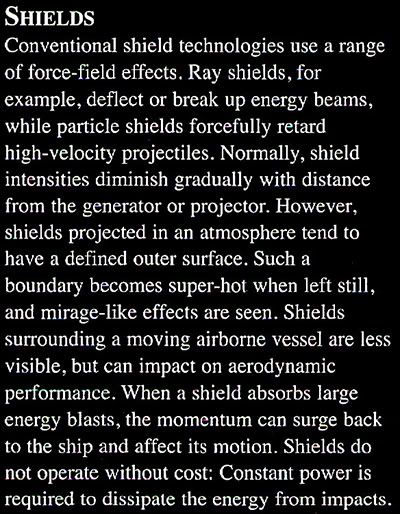
Nevertheless, those are shields with clearly defined boundaries, lending at least another tiny bit of credence to the static distance shield.
'Cause, honestly, even if this is interior trap shield and not starfighter, it's yet another example of such behaviour, while gradient shields don't seem to have any sort of higher canon examples :)
AOTC: Slave-I's firepower and Aethersprite's shields
-
Flectarn
- Bridge Officer
- Posts: 139
- Joined: Fri May 09, 2008 4:34 am
[quote= Darth Servo on SDN]
[quote= email to wong]If you assume an X wing has more fire power then the Enterprise D, your just being silly.[/quote]
Its not an assumption. Its a calculation based on the fact that Slave-1 caused more destruction in AOTC than the E-D could do in Pegasus with "most" of its photon torpedos. [/quote]
I read this thread earlier today...
and then came across http://bbs.stardestroyer.net/viewtopic.php?t=124869 thread on SDN.
not quite sure how they decided those asteroids in ATOC were bigger then the ones in Pegasus... but I guess they have.
Wish i had an ISP e-mail so i could bring it up there... but meh
*edit* actually on second thought I guess that notion refers to the seismic charge... which may be in that range... I havn't really seen calcs on it though
[quote= email to wong]If you assume an X wing has more fire power then the Enterprise D, your just being silly.[/quote]
Its not an assumption. Its a calculation based on the fact that Slave-1 caused more destruction in AOTC than the E-D could do in Pegasus with "most" of its photon torpedos. [/quote]
I read this thread earlier today...
and then came across http://bbs.stardestroyer.net/viewtopic.php?t=124869 thread on SDN.
not quite sure how they decided those asteroids in ATOC were bigger then the ones in Pegasus... but I guess they have.
Wish i had an ISP e-mail so i could bring it up there... but meh
*edit* actually on second thought I guess that notion refers to the seismic charge... which may be in that range... I havn't really seen calcs on it though
-
Mike DiCenso
- Security Officer
- Posts: 5839
- Joined: Fri Aug 18, 2006 8:49 pm
The whole "Pegasus" issue is dealt with again in other threads, and there are a variety of alternative scalings of the asteroid that put it in terms of volume well above the largest asteroids destroyed by the Slave-I seismic charges seen in AoTC by at least several orders of magnitude. More likely, based on the rather inefficent mechanics of the seismic charges, the Pegasus asteroid would simply be cut in half from a single dedonation rather than outright shattered into small bits.
-Mike
-Mike
-
Who is like God arbour

- Starship Captain
- Posts: 1155
- Joined: Fri Feb 02, 2007 3:00 pm
And, besides the size of the asteroids, one has to consider the composition of these.
The Pegasus asteroid has to have very heavy or at least unusual elements to be able to have »gravimetric or magnetic fluctuations inside« which could »overpower the engines on a shuttlecraft« and »shifts in magnetic field density« so strong, that the whole Enterprise was shaken through, when they had encountered them.
From the enginges of a shuttlecraft as well as the engines of the Enterprise is known, that they are strong enough to safely fly their spacecraft into the corona of a sun and back.
The conclusion would have to be, that that »small« asteroid has worse conditions regarding gravitation and magnetism than a sun. And that is only possible if the asteroid is uttermost unusual.
The Pegasus asteroid has to have very heavy or at least unusual elements to be able to have »gravimetric or magnetic fluctuations inside« which could »overpower the engines on a shuttlecraft« and »shifts in magnetic field density« so strong, that the whole Enterprise was shaken through, when they had encountered them.
From the enginges of a shuttlecraft as well as the engines of the Enterprise is known, that they are strong enough to safely fly their spacecraft into the corona of a sun and back.
The conclusion would have to be, that that »small« asteroid has worse conditions regarding gravitation and magnetism than a sun. And that is only possible if the asteroid is uttermost unusual.
-
Mr. Oragahn

- Admiral
- Posts: 6865
- Joined: Sun Dec 03, 2006 11:58 am
Please let's leave Pegasus out of this.
Besides, Darth Servo's post is just pure ignorance. One has to think he does it on purpose, no one can reasonnably assert that the Slave-I and its puny asteroid breaking bolts would surpass the firepower of the E-D if it had to destroy the 8-10 km long asteroid.
Besides, Darth Servo's post is just pure ignorance. One has to think he does it on purpose, no one can reasonnably assert that the Slave-I and its puny asteroid breaking bolts would surpass the firepower of the E-D if it had to destroy the 8-10 km long asteroid.
-
Jedi Master Spock
- Site Admin
- Posts: 2166
- Joined: Mon Aug 14, 2006 8:26 pm
Well, what happens is that first, the Slave I's firepower is calculated using very generous assumptions. Second, the E-D's firepower is calculated using very ungenerous assumptions.Mr. Oragahn wrote:Please let's leave Pegasus out of this.
Besides, Darth Servo's post is just pure ignorance. One has to think he does it on purpose, no one can reasonnably assert that the Slave-I and its puny asteroid breaking bolts would surpass the firepower of the E-D if it had to destroy the 8-10 km long asteroid.
The actual incidents are then removed from view before the two are compared. Thus, Servo compares not the actual incidents, but the calculations, each of which has been individually skewed and then accepted in isolation as a firepower figure.
-
Flectarn
- Bridge Officer
- Posts: 139
- Joined: Fri May 09, 2008 4:34 am
sorry to bring it up... it's just the juxtaposition was so severe, I had to say something, somewhereMr. Oragahn wrote:Please let's leave Pegasus out of this.
Besides, Darth Servo's post is just pure ignorance. One has to think he does it on purpose, no one can reasonnably assert that the Slave-I and its puny asteroid breaking bolts would surpass the firepower of the E-D if it had to destroy the 8-10 km long asteroid.
-
Mr. Oragahn
- Admiral
- Posts: 6865
- Joined: Sun Dec 03, 2006 11:58 am
-
Who is like God arbour
- Starship Captain
- Posts: 1155
- Joined: Fri Feb 02, 2007 3:00 pm
-
Mr. Oragahn
- Admiral
- Posts: 6865
- Joined: Sun Dec 03, 2006 11:58 am
-
Who is like God arbour
- Starship Captain
- Posts: 1155
- Joined: Fri Feb 02, 2007 3:00 pm
-
Mike DiCenso
- Security Officer
- Posts: 5839
- Joined: Fri Aug 18, 2006 8:49 pm
A more reasonable comparison, I think, is found in "Booby Trap" [TNG, Season 3], where the E-D vaporizes several modest-sized asteroids along with the Promellian battlecruiser. Sadly Trekcore doesn't have the full sequence, but there is a before the explosion, and a during the middle part of several torpedoes from the E-D hitting the battlecruiser and at least three other asteroids (remember to cut and paste all Trekcore links):
The Before screencap:
http://tng.trekcore.com/gallery/albums/ ... rap043.jpg
The E-D firing torpedoes, at least four in all:
http://tng.trekcore.com/gallery/albums/ ... rap231.jpg
The resulting explosion:
http://tng.trekcore.com/gallery/albums/ ... rap232.jpg
You can see very little, if any debris is generated by this strike, the explosion from the torpedoes keeps on expanding long after what the final screencap shows, filling the field of view before the scene cuts away.
One of the asteroids hit is the big one seen sitting next to the battlecruiser's starboard nacelle 7 o'clock. I make it out to be about 4.56 times smaller than the battlecruiser's overall "wingspan". How big is the battlecruiser? At one point the E-D while attempting to escape the asteroid field coasts past the derelict:
http://tng.trekcore.com/gallery/albums/ ... rap205.jpg
The battlecruiser's "wing" measures from nacelle to "fuselage" about 1.5 times smaller than the E-D saucer's radius of 235 meters, or about 156.77 meters wide. This is probably a low-end figure since the E-D's saucer is slightly nearer the camera than the battlecruiser wing is. But just going by that, we'll generate a further conservative figure by removing the width of the derelict's main hull from the equation. Thus 156.77 x 2 = 313.33 meters.
Plugging that in with the asteroid's size ratio of 4.56 gives us 68.7 meters for the asteroid's long axis. Given that the asteroid is behind the derelict battlecruiser, we can also assume that is a lower number. Plugging that number into Wong's asteroid destruction calculator, while also assuming hard granite, we would have about 252 kilotons just to melt the larger asteroid, and 1.3 megatons to vaporize it. But all of this also assumes an ideal dedonation of an explosive at the asteroid's center, and that only enough energy was imparted to do the work with little or no excess energy. We also clearly saw that the explosions from all the torpedoes continued well beyond the initially targeted asteroids, consuming possibly many others in the process since the goal as stated in dialog was to destroy all of the aceton assimilators that drain a starship's energy and entrap them. Given the time it took for the E-D to get clear of the field, the number and distribution of the devices was fairly widespread. It would take a great deal of firepower from a mere four torpedoes to clear such a vast area.
Final torpedo yeild: high kilotons to low megatons at the very minimum. Likely torpedo yeilds will be much greater than this.
I find the Warsie's claim of being "generous" in granting photon torpedo yeilds in the hundreds of kilotons to low single-digit megaton to be pure bunk when incidents in episodes like "Booby Trap" and "Rise" yeild far greater potential firepower. Thus we must reassess the "The Pegasus"
in a different light for yeilds, or discard it.
-Mike
The Before screencap:
http://tng.trekcore.com/gallery/albums/ ... rap043.jpg

The E-D firing torpedoes, at least four in all:
http://tng.trekcore.com/gallery/albums/ ... rap231.jpg

The resulting explosion:
http://tng.trekcore.com/gallery/albums/ ... rap232.jpg

You can see very little, if any debris is generated by this strike, the explosion from the torpedoes keeps on expanding long after what the final screencap shows, filling the field of view before the scene cuts away.
One of the asteroids hit is the big one seen sitting next to the battlecruiser's starboard nacelle 7 o'clock. I make it out to be about 4.56 times smaller than the battlecruiser's overall "wingspan". How big is the battlecruiser? At one point the E-D while attempting to escape the asteroid field coasts past the derelict:
http://tng.trekcore.com/gallery/albums/ ... rap205.jpg

The battlecruiser's "wing" measures from nacelle to "fuselage" about 1.5 times smaller than the E-D saucer's radius of 235 meters, or about 156.77 meters wide. This is probably a low-end figure since the E-D's saucer is slightly nearer the camera than the battlecruiser wing is. But just going by that, we'll generate a further conservative figure by removing the width of the derelict's main hull from the equation. Thus 156.77 x 2 = 313.33 meters.
Plugging that in with the asteroid's size ratio of 4.56 gives us 68.7 meters for the asteroid's long axis. Given that the asteroid is behind the derelict battlecruiser, we can also assume that is a lower number. Plugging that number into Wong's asteroid destruction calculator, while also assuming hard granite, we would have about 252 kilotons just to melt the larger asteroid, and 1.3 megatons to vaporize it. But all of this also assumes an ideal dedonation of an explosive at the asteroid's center, and that only enough energy was imparted to do the work with little or no excess energy. We also clearly saw that the explosions from all the torpedoes continued well beyond the initially targeted asteroids, consuming possibly many others in the process since the goal as stated in dialog was to destroy all of the aceton assimilators that drain a starship's energy and entrap them. Given the time it took for the E-D to get clear of the field, the number and distribution of the devices was fairly widespread. It would take a great deal of firepower from a mere four torpedoes to clear such a vast area.
Final torpedo yeild: high kilotons to low megatons at the very minimum. Likely torpedo yeilds will be much greater than this.
I find the Warsie's claim of being "generous" in granting photon torpedo yeilds in the hundreds of kilotons to low single-digit megaton to be pure bunk when incidents in episodes like "Booby Trap" and "Rise" yeild far greater potential firepower. Thus we must reassess the "The Pegasus"
in a different light for yeilds, or discard it.
-Mike
-
Mr. Oragahn
- Admiral
- Posts: 6865
- Joined: Sun Dec 03, 2006 11:58 am
As Vympel/Leo1 is doing it, again, I believe it would be most useful to have the quote from the AOTC:ICS that speaks about shield geometry in space vs. atmosphere: