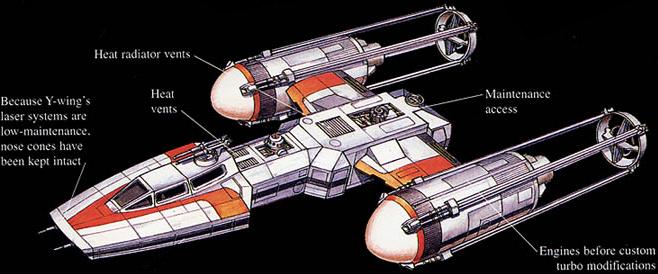
The question is just how an ISD, for example, is supposed to slow down, since it lacks frontal thrusters.
The idea that most people have been agreeing on is that they recreate a whole new path for the ejecta, by the help of forcefields.
Of course, one would say it would be simpler to just put holes in the front of your ship, but nevermind.
So since the engines on an ISD, despite being said to be ion engines I think, also use coned nozzles, we know that the good old rocket engine principle still as something to do here.
I came with a quick graphic about how the force fields should be shaped to generate a retro thrust.
It's rather rough, and doesn't specify that the rear cone should be created quite at a distance from the ship, to avoid redirecting the ejecta onto the ISD's stern, which would in return push it forward again to some moderate extent.
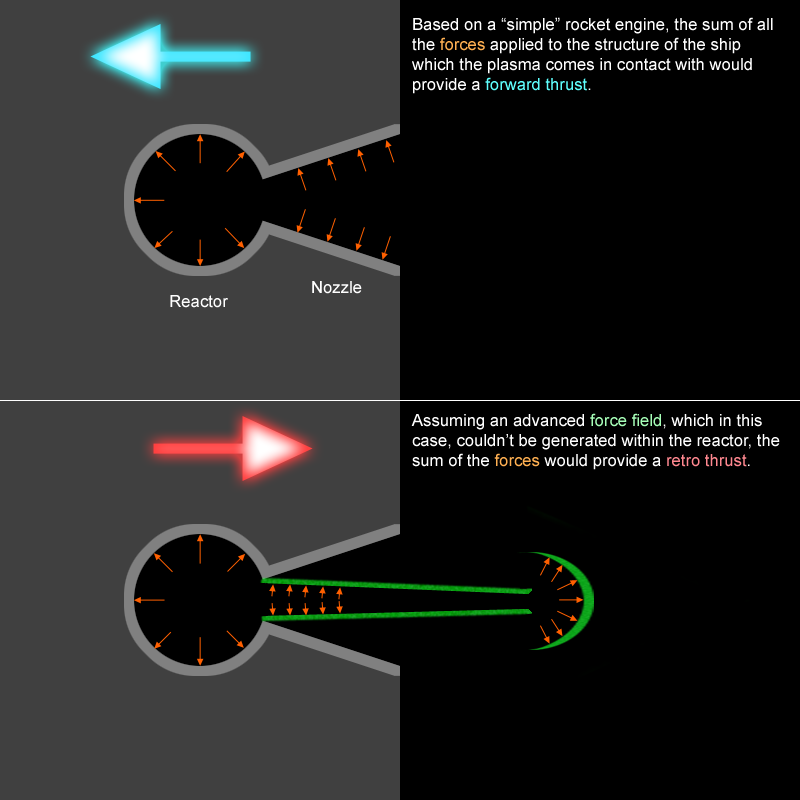
The green things are the forcefields. The tighter one has is a cone with its tip severed. This one should be shorter, I suppose. The second force field is a "bowl".
Does that look relatively good?
It doesn't include electromagnetic fields to accelerate, slow down or redirect ions btw.
Now, what do you think about the Invisible Hand's braking system, seen in ROTS?
Don't you think it would have been a tad better if the panels, instead of being purely planar, were shaped like lenses?
In the case of these planar panels, how much force do you think is actually lost due to scalar work?
Now, as a second part of this thread, do you think X-wings and hyperspace rings have the capacity to direct the ejecta forward?
What's the EU take on this? Do they say the openings are only radiators and air intakes (in case of atmospheric flight)?
Essential Guide: X-wing
ICS: hyperspace module
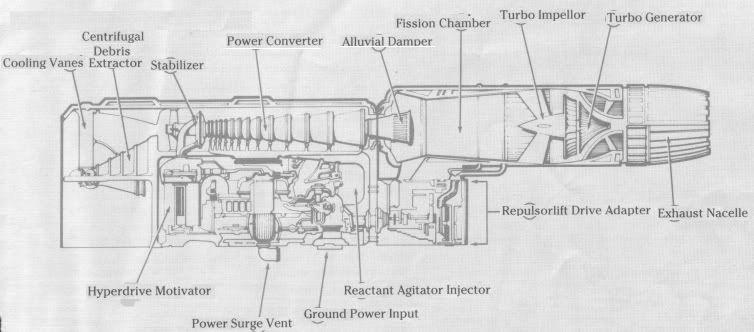
Star Wars Sourcebook (a cross section not too different than the one from the ICS).
It seems the design doesn't allow the engine to redirect the ejecta forward.
The structural design of Y wings' engines is interesting. It seems to allow for a great mix of solid and force field deflectors to easily reorient the ejecta.