Mr. Oragahn wrote:
Eh?? What each chasm? We essentially always see the same face of the asteroid, with varying degrees of zoom. vivftp properly pointed out a couple of those features, and anyone can complete the work rather easily.
The two chasm next to each other. You can clearly see them in the overall view of the asteroid. But for now, just to keep things conservative, I'll concede to your work.
Mike DiCenso wrote:Other issues curiously neglected are the reasons Pressman orders the E-D into the chasm in the first place; because the gravitational and magnetic flux of the asteroid can overpower a shuttlecraft's engines.... A very odd thing since shuttlecraft have demonstrated repeatedly throughout the various incarnations of Trek to be able to withstand normal terrestrial sized planet and even gas giant sized gravitational and magnetic fields. The density of this asteroid would have to be astounding to do such a thing!
Mr. Oragahn wrote:
Surely, that's another problem. You density that's required to generate gees that would overpower engines which can leave Earth within a few minutes tops would be incredible.
How the asteroid in question didn't reach hydrostatic equilibrium is odd.
The whole thing is perhaps even more contradicted by the time the Romulan ship melts the cavity's entrance with disruptors. Did we see any gout of molten material fall towards the core of the asteroid, and hit the E-D for example?
Surely, if the gravity is so strong that a shuttle couldn't control entry and even exit, damaging the asteroid's integrity would have surely resulted in something much more hazardous than a cleanly sealed entrance. I would have expected something more like a rain of debris and a newly formed giant stalactite made of asteroid material, pointing "corewards".
Then, perhaps, and I may say once again, we're dealing with more Trek physics, aka pure nonsense.
Except that the molten material does flow "downwards' into the asteroid within minutes of the warbird's firing on it. The only other explanation is that the warbird pushed the material in with focused weapons fire, or with a tractor beam.
As for the nonsense of it, I agree, but nonetheless, it is a canon fact. So do we charge this up to FX incompetence for not making an asteroid that was larger and more spherical, or assume that Data is an idiot?
Mr. Oragahn wrote:OK. The main problem would be, here, that we can't know how far from the asteroid the Romulan ship is.
Mike DiCenso wrote:I disagree, but it would take some trigonometry since in the exterior shots we can see the E-D and warbird and can calculate their distance to one another, and then confine the width of the asteroid within that.
-Mike
Mr. Oragahn wrote:
Well I'll let you do that, since as far as I'm concerned the methodology that uses the E-D as a yardstick is good enough.
I did some work on it. Roughly speaking I get a distance of warbird to camera in the 126 image of 7 km and from the E-D to camera of 886 meters. So about 6,100 meters seperates the two ships. Now that seems a bit small, and my math may be a bit faulty, but then I realized that the two ships are at an angle of some 30-45 degrees off the asteroid's center and this may throw everything off even more, as this may make the thing far larger since the distance would cover only across that section, not the whole asteroid.
As for the E-D as reliable yardstick, I would point out that the height of the ship is skewed here and no one source agrees on it how tall it is: some placing it only at 137 meters, while others estimate it at 150 meters, and the DS9 TM is way out there with 193 meters (not possible within the proportions we see). However within a meter every source places the ship at 641 to 642.5 meters. Call it 642 meters.
Using your images:
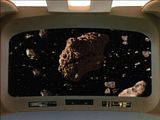
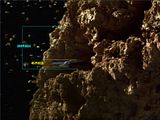
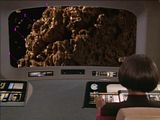
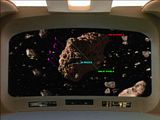
Measuring the chasm opening of 2.51" to the E-D length 1.85" (measuring from the narrowest parts of the chasm) I get 873 meters. Again using the images provided here, dividing 362.4 pixels by 34 I get a ratio of 10.66 to 1. 10.66 x 873 = 9.306 km. Measuring the wider parts of the chasm I can get the asteroid length up to 10 km. So that's a third to a full km or more longer using the ship's length, not height. Of course using one of the larger estimate averages for the ships height I can put it in that 10 km range. 160 meters x 5.78 = 924 m x 10.66 = 9,858.36 m.
Starting to get my point now?
Mike DiCenso wrote:
Among other things people in that thread, most suprisingly l33telboi missed, was that Kirk's statement was that a 97.835 MT explosion results from overloading a single starship's impulse engine. Thus 98 MT is a very lower limit there. But I digress. The interesting thing is the photon torpedo explosion examples which show that torpedoes rarely leave large fragments behind when they destroy asteroids and starships. The "Rise" incident was an anomaly, and was even as part of the plot acknowledged as one that was throughly investigated by the Voyager crew, and they soon discovered the asteroid there was made of artifical alloys and one natural one that was prone to fragmentation.
Thus one has to conclude that when Riker means the asteroid in "The Pegasus" is to be destroyed, he means mostly vaporized or reduced to tiny pieces vastly smaller than 10 meter chunks.
Mr. Oragahn wrote:Nope. Because small asteroids largely vanish after being hit, it doesn't automatically translate in Riker thought that the big ass one would be largely vaporized.
That makes no sense. Assuming 100 megaton torpedoes as per the rise calculations, then 250 torpedoes x 100 MT = 25,000 MT or 25 gigatons. That's more than enough to signficantly vaporize a spherical asteroid of those dimensions, never mind an irregularly shaped one. On the other hand, if we look at it the other way, knowing that vaporization is possible such that only tiny bits remain, then 768 gigatons divided by 250 torps = 3 gigatons per torpedo. Riker's thought, as the dialog shows, is to utterly destroy the thing and the
Pegasus to ensure not a single bit remained for Pressman or the Romulans. Under your scenario, Riker is an idiot who will just be happy with leaving behind large chunks and possibly large pieces of the ship.
On top of that, as noted earlier, Riker has no idea exactly what it will take. He gave an off the cuff option, one that ensures total destruction. We also cannot quantify exactly what "most of" the 250 torpedo loadout means. Is it 150, 165, 200 , or 249 torpedoes to do the job? Brian Young assumes 275 were expended (the number per the TNG TM, not the canon 250 number given in "Conundrum").
So what this comes down to is at very minimum "The Pegasus" points to low single digit megatons, and on the upper range low single digit gigatons.
-Mike


